

Legislation Excluding South Carroll’s Virtual Enrollment Funding May Be Unconstitutional
From the Apr 7, 2026 e-Edition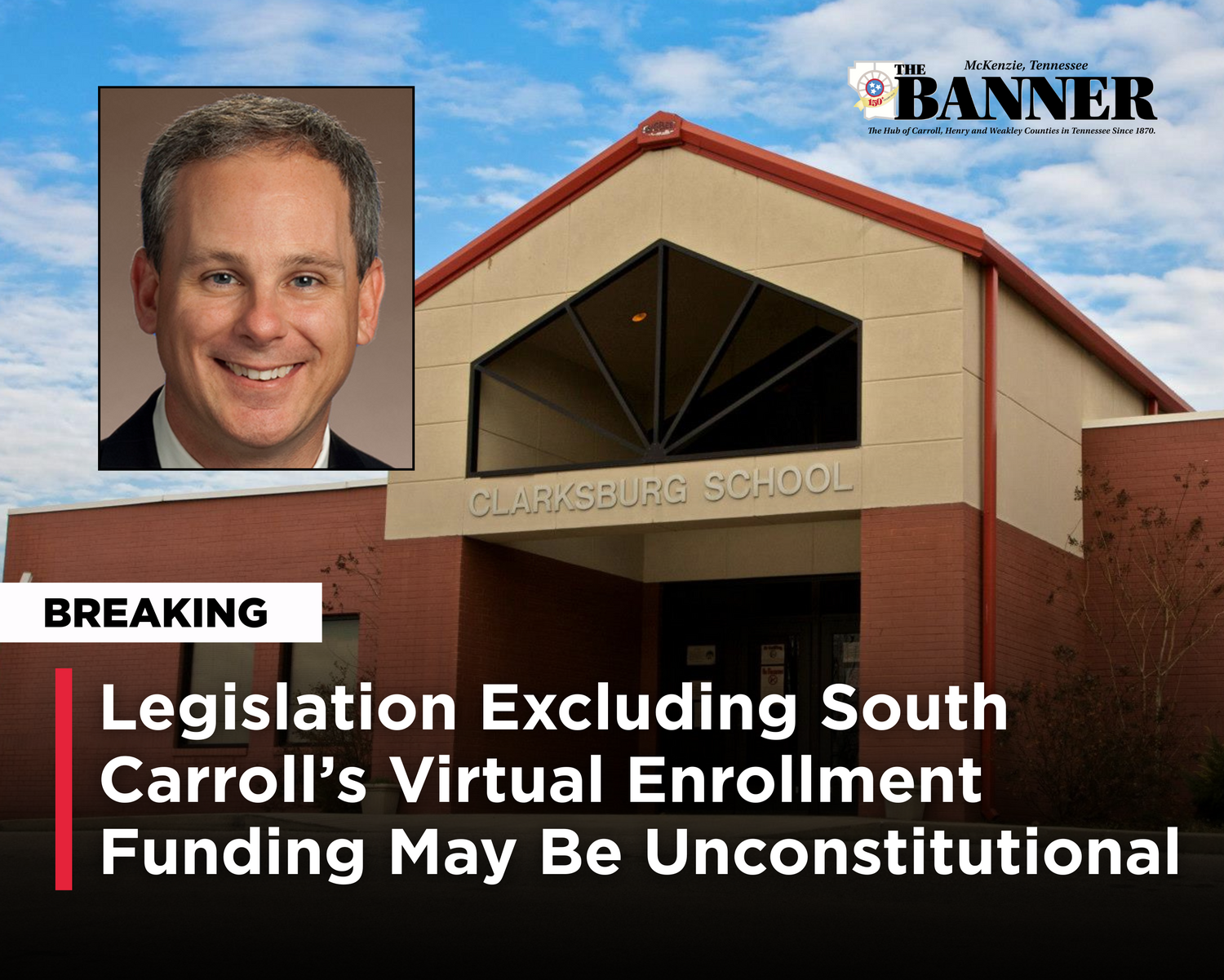
NASHVILLE (April 6) — Sen. John Stevens and Rep. Brock Martin’s proposed legislation to reassign local option sales tax funding from South Carroll Special School District to other county schools may be deemed unconstitutional, in a new development.
In February, Stevens and Martin (both R-Huntingdon) introduced SB2188/HB2388 and a planned amendment that would exclude South Carroll’s two virtual schools from the local option sales tax funding formula.
The bill only applies to Carroll County.
Education Committee Chairman Mark White verbally confirmed to South Carroll Special School District officials that SB2188/HB2388 is potentially unconstitutional as it targets only one of the 147 public school districts in Tennessee.
There are 65 virtual schools in Tennessee with 25 of those schools operating state-wide. However, South Carroll’s virtual schools are the only ones affected by this legislation.
White reportedly asked Tennessee Attorney General Jonathan Skrmetti to give a notification of the bill’s unconstitutional nature.
Articles within the Tennessee Constitution prohibit impermissible class legislation. This has been interpreted to guarantee Tennesseans a right to equal protection that mirrors the U.S. Constitution, Fourteenth Amendment’s Equal Protection Clause.
Article XI: Section 8 of the state Constitution reads, “The Legislature shall have no power to suspend any general law for the benefit of any particular individual, nor to pass any law for the benefit of individuals inconsistent with the general laws of the land; nor to pass any law granting to any individual or individuals, rights, privileges, immunitie, [immunities] or exemptions other than such as may be, by the same law extended to any member of the community, who may be able to bring himself within the provisions of such law.”
Additionally, Tennessee Code Annotated (T.C.A.) § 49-3-315(a) states, "[all] school funds for current operation and maintenance purposes by any county ... shall be apportioned by the county trustee among the LEAs in the county on the basis of the WFTEADA maintained by each, during the current school year."
This T.C.A. article was used to defend a 2012 opinion by the Tennessee Attorney General, ruling that a municipal school district in Shelby County was required to receive funding from countywide property taxes based on WFTEADA.
LEA stands for "local education agency," and WFTEADA stands for "weighted full-time equivalent average daily attendance."
The issue arose when South Carroll Special School District sought to solve its own funding issues by launching two state-wide virtual schools on July 1, 2025, Clarksburg Virtual Academy (Grades 6–12) and Clarksburg Adult Virtual High School, which serves learners aged 17 and older throughout Tennessee.
In May 2025, Dr. Lisa Norris, Director of Schools and Principal of the new virtual programs, said, “South Carroll is expanding to ensure we remain competitive in a rapidly changing education market. The Education Freedom Act has challenged us to engage in a statewide academic environment, and these virtual options allow us to do just that—while continuing to meet the diverse needs of today’s learners.”
The virtual addition has boosted South Carroll’s enrollment, but the success hasn’t exactly been well-received by the other districts that stand to lose funding due to the current funding formula.
Sen. Stevens worked with local legislators, including state representatives Tandy Darby and Brock Martin, along with the Tennessee Department of Education and legislative attorneys, to craft language addressing the problem.
The proposed amendment would require that only students who live within a district or county be counted when calculating enrollment totals used in the formula for distributing the state share of local sales tax. Students enrolled in virtual programs would not be included in that count.
Meaning, South Carroll would still have the virtual school enrollment and related expenses, but not the state-allocated funding to go along with it.
Tennessee public schools’ current funding model, TISA, requires 30% of funding to come from local option sales tax. The other 70% comes from TISA’s four-part funding criteria.
“It’s just part of the TISA formula,” said Dr. Norris, “and it’s needed for operations.”
Both of South Carroll’s virtual programs are 100 percent tuition-free, so the district does not receive funding directly from students. Upon admission, students receive a laptop provided by the school. The school district also hired two state-certified instructors for the virtual program.
Stevens said his bill would bring the distribution method closer to the system previously used.
Local sales tax revenue in Carroll County is divided among districts based on average daily enrollment. As the virtual school’s statewide enrollment increases, the district’s share of the county’s sales tax revenue also rises.
School leaders across the county have warned that the situation could reduce funding for their districts.
Director of Schools Dr. Justin Barden said McKenzie Special School District could face an estimated loss of about $126,000.
Dr. Jonathan Kee, director of the Huntingdon Special School District, said his district could lose at least $125,000 if no legislative action is taken.
Preston Caldwell, director of the West Carroll Special School District, said earlier in March his district could lose up to $67,000 if the formula remains unchanged.
South Carroll has yet to receive any additional funding for its virtual schools because funding is determined by the previous school year’s enrollment. The estimated totals are projected based on the 2025-2026 school year’s TISA funding. Official numbers are expected in June 2026.
TISA stands for Tennessee Investment in Student Achievement. It is the new public school funding formula signed into law in May 2022.
TISA takes into account the base funding amount provided for every public-school student; weighted funding to address individual student needs including those students who may be low-income, students with disabilities, or live in a sparse or small community; direct funding intended to support early literacy, career and technical education (CTE) programming, and postsecondary readiness; and outcomes funding based on student achievement.
Stevens said lawmakers considered a proposal that would have required sales tax revenue to be collected from each virtual student’s home county. However, he said such a plan would likely fail because it would affect multiple counties across the state.
“That would kill the bill because, obviously, other counties and other members who would lose their money would kill the bill,” Stevens said, describing the idea as a “poison pill” for the legislation.
Instead, the amendment was written so that the legislation applies only to Carroll County and does not alter funding formulas elsewhere in Tennessee.
SB 2188/HB 2388 reads, “An act to amend Tennessee Code Annotated, Title 5 and Title 49, Chapter 3, relative to the apportionment of education funding in a county in which an LEA has established a public virtual school.
“Local Education Agencies [LEAs] - As introduced, limits, for Carroll County, the weighted full-time equivalent average daily attendance [WFTEADA] for which the county is required to apportion all school funds collected by the county for current operation and maintenance purposes to that generated by students whose primary legal residence is located in Carroll County. - Amends T.C.A. Title 5 and Title 49, Chapter 3.”
On March 30, on third and final consideration, Stevens referred the bill back to the Senate Calendar Committee, with no objections.
The calendar committee is responsible for scheduling bills and resolutions for consideration by the Senate.
Sen. Stevens represents Tennessee District 24, which encompasses Benton, Carroll, Gibson, Henry, Houston, Obion, Stewart and Weakley counties.
Rep. Martin represents Tennessee District 79, which includes the southern half of Carroll County and portions of Gibson and Henderson Counties.
Both White and Skrmetti’s offices were contacted for comment and documentation of this development, but did not respond by press time.
Updates will be provided as they become available.
An update received on Friday, April 10 from Deputy Press Secretary for the House Republican Caucus Paris Vinnett read, “The status of HB 2388 indicates it has not been heard this year. Rep. Martin is collaborating with local and state stakeholders to ensure alignment and position the bill for a clear path forward next session.”
More Photos & Video
In the e-Edition
McKenzie Banner April 7, 2026
Apr 7, 2026 · Read the full issue →